

These videos are for children of all ages - and the grown ups who care about them.
Kids:
You don’t have to do these “right.” You can be silly, laugh, move your body, stop early, or change the activity to suit you. Some activities will work really well for you, and some won’t — that’s normal. You’re the expert on your own body.
If you’re a teenager, you’re welcome to watch, roll your eyes… and then maybe try it anyway. Or don’t. (But it usually helps.)
Parents and Carers:
These activities are evidence-based and support emotional regulation, safety, and recovery after stress or trauma. They can all be done using everyday items you already have at home — no special equipment or purchases needed. Doing them together can also be a gentle way to support children without pressure or big conversations.
Watch a Video
Press play, try one thing, and see how your body feels.
Even a small break can help big feelings settle.
Introduction
Busy Brain Breaks are simple, fun activities to help big feelings settle.
These videos are for kids of all ages (and the grown-ups who care about them).
When your brain feels loud, your body feels wiggly or tired, or feelings feel like too much, you can try a Busy Brain Break. You don’t have to do it “right.” You can be silly, laugh, stop early, or change it to suit you.
Some activities will help more than others — that’s normal. Use what works for you.
Parents and carers: these are evidence-based activities that support calm and regulation, using everyday items you already have at home. Press play, try one thing, and see how it feels.
Even a small break can help big feelings settle.
Belly Breathing
Take something and place it on your tummy.
Watch it go up and down… wobble and fall.
Breathe in 1, 2, 3… and out.
Can you hear your breath?
What does it sound like?
Can you make it louder? Now super soft?
Spinning Around and Around
Take a spin around and around.
Notice how your body feels.
Fast… slow… dizzy?
Some people love spinning.
Some people don’t — and that’s okay.
No egg chair?
You can spin standing up…
or twist a swing at the park.
What does your body say?
Is it a yes?
Or a no?
Cuddle Time
Time for cuddle squeezes.
Big, gentle, tight squeezes.
With a grown-up you trust…
or wrap your arms around yourself.
Squeeze… and hold.
Then let go.
Does your body feel calmer?
Warmer?
Safer?
Count Your Teeth
Let’s try something you can do anywhere.
Count your teeth.
How many can you feel?
Use your tongue to gently roll over them.
Top… bottom… front… back.
Keep counting.
Did you miss any?
This helps your busy brain slow down.
Mindful Bites
Pick a bite of food. Any food will do.
Look at it closely. Smell it. Touch it.
Notice the colours… the shapes… the textures.
Now put it in your mouth.
Slowly. Really slowly.
Chew carefully. Feel it change.
What does it taste like?
Can you notice all the flavours?
All the feelings in your body as you eat it?
Shrug and Sigh
Shrug… up, up, up to your ears!
Now drop your shoulders… and let out a big, long sigh.
Up… and down…
Notice how your shoulders feel.
Sometimes feelings can feel heavy here.
Let them move through your body.
Moving and sighing helps your body tell your brain it’s safe to relax.
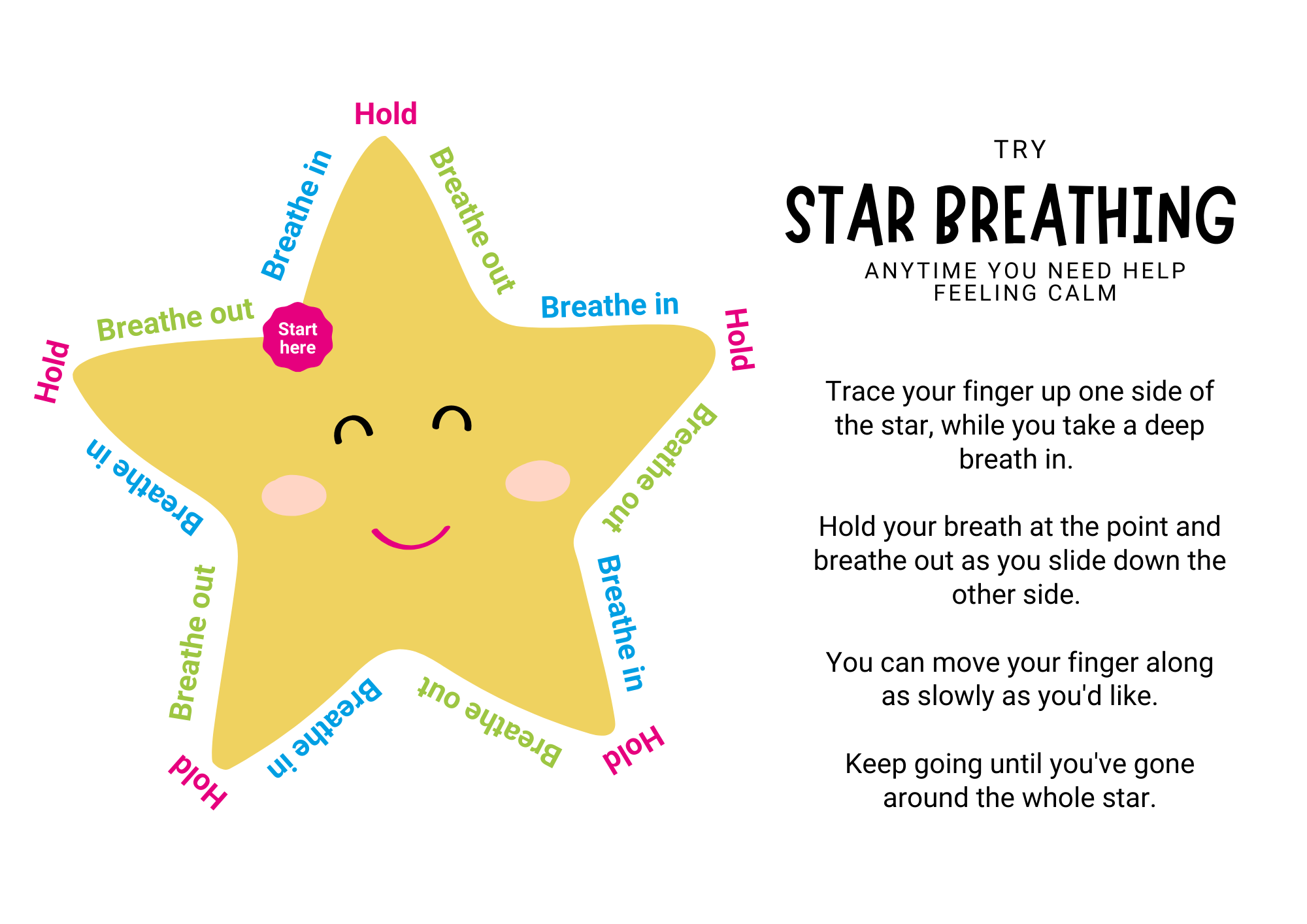
Star Breathing
Put one hand in front of you.
Use the fingers of your other hand to trace along each finger… up and down.
Breathe in as you move up…
Breathe out as you move down.
Move quickly… or slowly…
Notice the touch on your fingers.
Can you hear your breath?
Does it tickle?
This gentle movement and breath help your body and brain feel calm and steady.
Stretch and Pull
Grab something stretchy—a band, a towel, a scarf, or even a belt!
Hold it tight in your hands.
Stretch your arms out…
Pull…
Stretch…
Pull…
Feel your muscles wake up.
Do you feel strong?
Does it feel loose?
You can go slow… or fast…
Stretching and pulling like this helps move big feelings through your body.
Tight Squeeze
In this video, we’re using stretchy body socks to give our muscles a big, gentle squeeze… but you can use what you have at home.
Try wrapping up in a blanket like a burrito- now stretch out inside it. Jump into a pillow case or a blanket cover or a sleeping bag. Use your strength to move around inside it, and to stretch it out.
How does that feel?
Wall Push Ups
Got big, buzzy energy? Does it feel too big?
Let’s push it out.
Stand next to a wall. Hands flat. Ready?
Push. Push. Push. Harder… stronger… stronger.
Can you move the wall? No, silly billy. but your muscles are working! Feel your arms getting strong.
Big pushes help your busy body calm down and feel in control.
Show me those strong muscles.
Tug of War
Do you ever feel so annngrrryyy? Or like you have so much energy and don't know what to do with it? Try Tug of War.
Grab a blanket or a bedsheet or a towel and another person and play some silly tug of war- forward and backwards until you can grab the blanket all to yourself.
Have fun!
Smell and Tell
This is a fun game where you get to use your sense of smell to guess different items around your home.
What did you find for your friend to smell? A smelly sock?
Taste and Tell
We experience the world through our senses. They wake us up and keep us alert and can also calm us down- just by focusing on them.
This is a fun game where you get to use your sense of taste to guess different foods around your home.
What did you find for your friend to taste? Something sweet? Or icy cold? Something sour or something crunchy?
Touch and Tell
We experience the world through our senses. They wake us up and keep us alert and can also calm us down- just by focusing on them.
This is a fun game where you get to use your sense of touch to guess different textures around your home.
What did you find around the home?
Did you find something big and fluffy and soft like a teddy bear? Or something rough and prickly like a scourer? Maybe something stretchy like an elastic band?
Story Time
A note for parents:
These videos can all be found on our Storytime Page, but we chose to include these videos here because recently, our children have been holding feelings that feel huge and they express that through their behaviours. These stories can give your child words and ways to learn about those huge feelings and how to manage them and express them in ways that feel safe. They’re designed to help children feel seen, capable, and confident as they learn social-emotional skills.
I Can Handle It
Written by Laurie Wright and illustrated by Ana Santos.
In My Heart
Join us as we read "In my heart, a Book of Feelings". Written by Jo Witek and illustrated by Christine Roussey.
Activity 1: Print feelings cards and enjoy 5 games together. You will need- scissors and glue. Click here to access free printable.
Activity 2: Create your own feelings faces. You will need: paper or paper plate, textas/crayons/coloured pencils, and if you want to take it to the next level- glue, scissors, string, googly eyes, playdough, cut out shapes etc. Click here for face ideas and free printable.
Activity 3: Change the lyrics to "If you're happy and you know it" and play Simon Says with a twist.
When I'm Feeling Angry
Join us as we read "When I’m Feeling Angry" Written and illustrated by Trace Moroney.
Activity 1: “When I feel angry” board/ box. Sit down together and have a think about what helps you and your child when you feel angry. You will need paper, colours, scissors and glue for the board OR household items for your calm down box. Draw an angry face in the middle of the page and draw calming down activities around it. Ideas include exercise, stretching, blowing up a balloon, squeezing playdough, scribbling, crying, running your hands under water etc. and you can draw pictures, or add visual prompts to your board. You can also create a box that has in it a balloon, straw, crayons and paper, play dough, something that smells nice, something stretchy, something rough. Click here to watch a video about creating your very own Messy Feelings Masterpiece. Click here for 5 ways to make your own squishy ball.
Activity 2: Shape Breathing. You will need a printer, crayons/textas/ pencils and scissors. Or if you don’t have a printer you can draw the shapes yourself. Decorate the shapes and trace the perimeter with your finger as you breathe. You can cut them out, laminate them and pop them into your calm down box. Click here for printables.
Activity 3: Monster Bubbles. You will need a cup, milk OR water and a straw. Fill up the cup half way with liquid and blow through the straw. A fun everyday activity, and also a great activity to calm angry feelings. Or to create even bigger bubbles you will need a bowl, half filled with water and a few drops of liquid dish soap. Place a towel underneath the bowl and pour some drops of soap into the water. Pop the straw into the bowl and blow… See those monster bubbles grow and bubble out of the bowl.
Click here for more resources for helping children manage anger.
Grumpy Monkey
Join us as we read "Grumpy Monkey". Written by Suzanne Lang and illustrated by Max Lang.
Activity 1: Ocean in a bottle. You will need an empty plastic bottle, vegetable oil, water and food colouring. Click here for instructions.
Activity 2: Action card game. Print out these cards, colour them in and cut them out carefully. You can play a matching game with them or an action card game. Take turns doing the actions/movements and you may find yourselves rolling around laughing with your children. Click here for printable cards.
When I'm Feeling Loved
Join us as we read "When I’m Feeling Loved". Written by Trace Moroney.
Activity 1: Make a list (write or draw) of people that you love and love you. Discuss the idea of love being limitless – no matter how many people we love, there is always more love in our hearts.
Activity 2: Get creative and make a card for someone you love. Ask your child who they would like to make a card for and talk about why they chose that person. Is that person kind to them? Do they enjoy spending time with that person? Think about how that person makes you feel and how we can try to display those same qualities to other people around us.
Activity 3: Experiment time. Get some cups filled with water, food colouring and paper towel and what the coloured water running up the paper towels. This is how love and happiness and move from one person to another. Click here for instructions.
Don't Worry Grandpa
Join us as we read "Don’t Worry Grandpa". Written by Nick Ward.
Activity 1: Guess the feeling game part one. Click here to print out a copy of feeling cards. Spread out a set of cards face up. Take turns to choose a card but don’t tell the other players the card you have chosen. Tell a short story about a time you felt like that and see if the other players can guess which card you chose.
Activity 2: Guess the feeling game part two. Using the same cards from the previous activity. Spread out a set of cards face up. Take turns to choose a card but don’t tell the other players which you have chosen. Make a face and see if the other players can guess which card you chose just from your facial expressions. Click here to show your prereaders a video example of the game.
Activity 3: Thunder cloud weather craft. You will need white paint for clouds, yellow paper for lightning bolts and glitter to make the page shimmer for the lightning show. Click here for an example.
Activity 4: Rain cloud in a jar. This is a weather science experiment giving your children a chance to explore clouds and rain in a hands-on and engaging way. You will need shaving cream, clear jug/cup filled with water, food colouring and a liquid dropper or syringe. Click here for instructions.
I Am Human
Join us as we read “I Am Human”. Written by Susan Verde and art by Peter H. Reynolds.
Activity: I am Human wordsearch. Click here to play online. Click here to download a printable version.
Be You!
Join us as we read "Be You!”. Written by Peter H. Reynolds.
Activity: Colouring page. When you are colouring it in, have a think about 5 things that you can do that make you feel calm.
I Can Do It!
Join us as we read "I Can Do It!”. Written by Laurie Wright and illustrated by Ana Santos.
The Feelings Book
Join us as we read "The Feelings Book" written by Todd Parr.
How Do You Feel?
Join us as we read "How Do You Feel" written by Lizzy Rockwell.
Activity: Click here for some printable feelings cards and a bunch of different games you can play with them.
Say Something
Join us as we read "Say Something" by Peter H. Reynolds.
Activity: click here for the say something activity pack, a pdf filled with wonderful actvities.
The Way I Feel
Join us as we read "The Way I Feel". Written and Illustrated by Janan Cain.
Activity: Click here and play this feelings game with your very own paper plate faces.
I Was So Mad
Join us as we read "I Was So Mad" by Mercer Mayer.
Activity: When you finish reading this book with your child, have a discussion about what makes your child sooooooo mad. You can also share what makes you feel sooo mad. Continue to discuss ways to express yourself when you feel mad. There are healthier ways and less healthy ways to express our anger.
The Chameleon that Couldn't Change
Join us as we read "The Chameleon that Couldn't Change". Written by Little Life Lessons and illustrated by Richard Merritt.
Activity: Pick-A-Boo with a difference. Take a cloth or scarf or small blanket to cover your face. Then slowly lower the cloth as your face/ body language shows a feeling (angry, sad, excited, disappointed etc.). Ask your child to guess the feeling. Do this a few times with different feelings, and take turns with your child. Whilst you are playing you can talk about the importance of sharing all of our feelings with someone we trust and feel safe with, reasons why people might hide their feelings and what can happen when we hide them away. Safe spaces create opportunities for sharing.
Waiting Is Not Easy
Join us as we read "Waiting Is Not Easy" by Mo Willems.
Activity: Is there something that your child is looking forward to? Or maybe they are finding it difficult to wait for something. Together you can create a countdown. Little shapes can represent the days, or hours and together you can check them off as the time passes. Click here for an example. In this example you can see that while my son was waiting for his dinasaur costume to arrive, he used strong strokes with his pen. This is a way for him to express his excitement, or frustration or other feelings as he waited.
Blaire's Battle with Anxiety
Join us as we read 'Blaire's Battle with Anxiety'. Written by Karly Henderson.
Blaire shares some ideas that help her when she feels anxious. What helps you?
Fill a Bucket
Join us as we read "Fill a Bucket- A Guide to Daily Happiness for Young Children". Written by Carol McCloud and Katherine Martin M.A and illustrated by David Messing.
Activity: Click here for a Bucket filler word search.
Happy Dreamer
Join us as we read "Happy Dreamer". By Peter H. Reynolds.
We love you just the way you are! You are really good at being you!
Will You Fill My Bucket?
Join us as we read "Will you fill my bucket?" Written by Carol McCloud and Karen Wells. Illustrated by Penny Weber.
Sometimes we just need a huge cuddle from someone we love.
When you feel that you need your bucket to be filled- Ask for it!
If you are looking for more fun, check out our other kids pages


