What's My Role?


When we were in the thick of this journey, I unconsciously put the pressure on myself to be the tutor and therapist and teacher and friend as I tried to fill the gaps for my son and prop him up. The pressure was too much and at some point, his Occupational Therapist said to me that my role is TO BE HIS MUM. What does that even mean? My role is to be a leader in my family and ensure that my child is safe and loved unconditionally. Full stop. This was so validating and empowering to hear.
When I stopped spending two hours trying to help with homework, and stopped trying to assess his behaviours etc. it took a tremendous weight off my shoulders and allowed me to focus my energies on being what I needed to be for him- which is a lot easier to do without the extra pressure! I was able to let go of those ‘roles’ that I had placed on myself, knowing that each team member was doing their job (OT, teacher, special education teacher, therapist etc.)

Okay, so if my job is to make him feel safe, how do I do that?
It starts with accepting that this is where things are at.
Your child’s brain works differently to yours. What may seem like a simple task for you, can be insurmountable in their eyes. And that is okay. The challenges that they face as the grow up, may be different to the challenges you faced. Part of this process is letting go of the “should have’s” or the “supposed to’s” and accepting what is right now, and what might be moving forward.
When you can accept this, then you are in a position to help your child process their diagnosis and understand how their brain works.
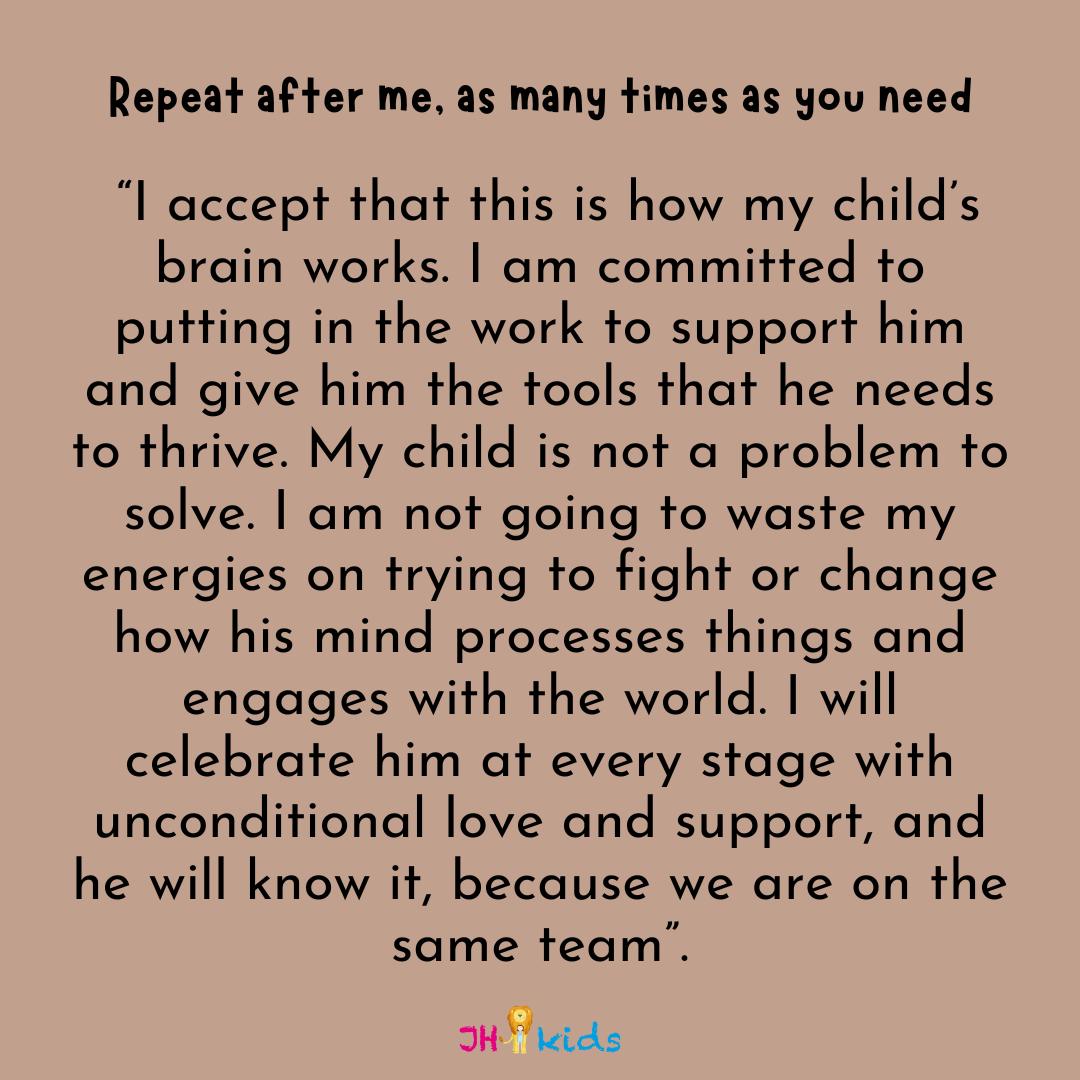
Repeat after me, as many times as necessary in a day-
“I accept that this is how my child’s brain works. I am committed to putting in the work to support him and give him the tools that he needs to thrive. My child is not a problem to solve. I am not going to waste my energies on trying to fight or change how his mind processes things and engages with the world. I will celebrate him at every stage with unconditional love and support, and he will know it, because we are on the same team”.
Next, we want to put our efforts where they are helpful- in advocating for my child (and teaching him to advocate for himself), and making accommodations to help him feel safe and in an optimal state to engage with the world.
None of these are one off suggestions. They aren’t something we tick of a list and move on from but rather, they are ongoing.
Feel free to skip straight to any of the sections below.
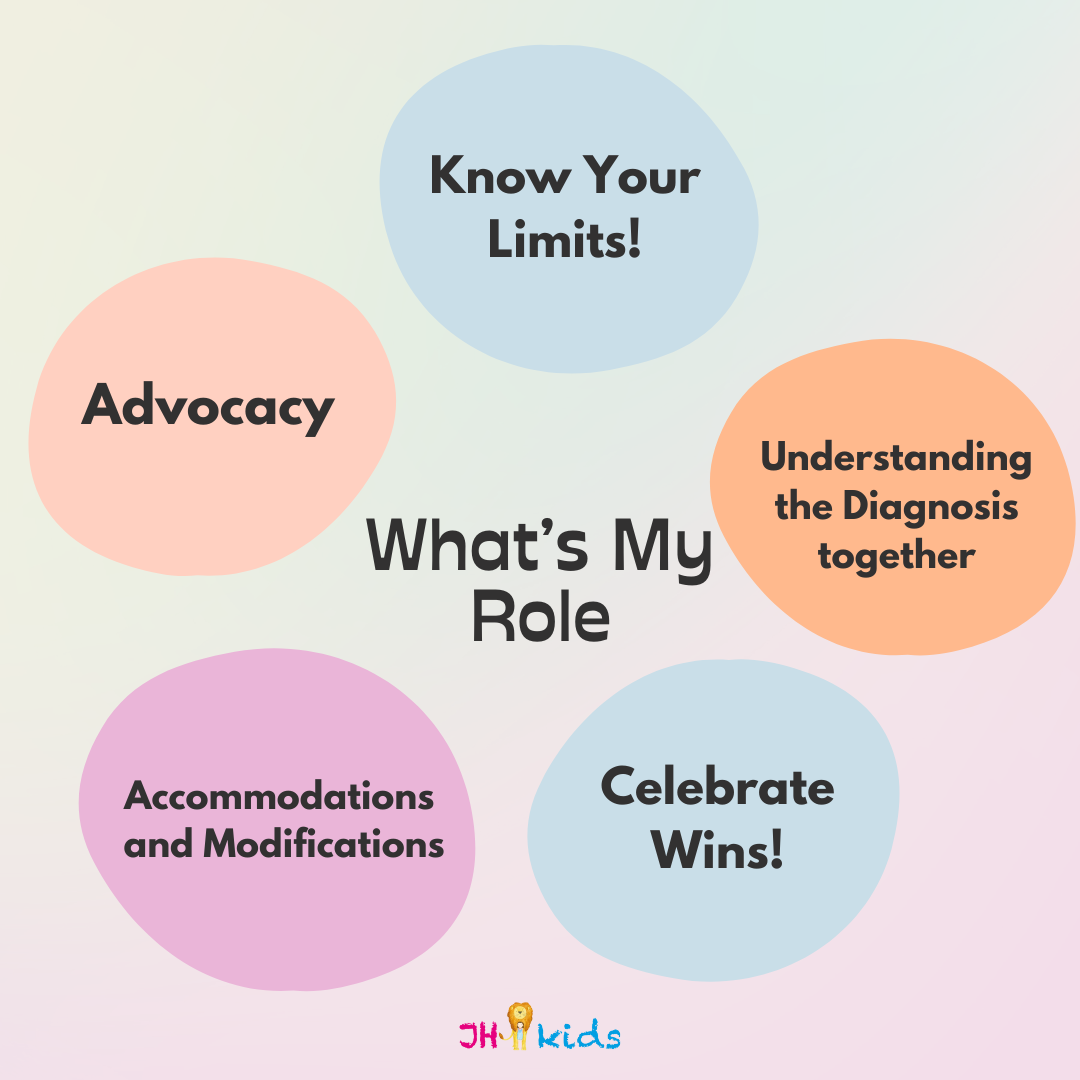
1. Advocacy
2. Accommodations and Modifications
3. Understanding the diagnosis together
4. Knowing your limits
5. Celebrate the wins!
Advocacy
What is my sphere of influence? What can I control and what can I not control? Do I have it in me to do this, or do I need to outsource this to someone else in the team? That is okay!
What does it mean to advocate for my child?
Stand up for your child’s rights to create change and ensure that he is receiving what he is entitled to- either on a personal or more global level. It means being the voice that represents what my child’s needs are, and making sure that everything that can be done, is being done.
We are advocates at home, at school, in public spaces. We can also teach our child to advocate for himself: self-advocacy.
These are the four C’s that we want to have when we advocate.
CALM- Can I do this in a calm way?
COMPETENT- Do I know what I am talking about?
CONFIDENT- Can I confidently show my knowledge and do what needs to be done?
COMPASSION- Can I have compassion for my child, myself and for the person/structure I am advocating with.
In this video we share an example:
Advocacy can involve:
- Education and awareness about the strengths and challenges associated with your child's diagnosis. We need to first educate ourselves and then family, friends, community and the school system where needed.
- Navigating systems to ensure my child receives appropriate support and accommodations tailored to him. This means knowing the law, and his entitlements.
- Teach self-advocacy skills to my child and help them to understand and embrace their neurodivergence.
- Challenging stigma and misconceptions associated with neurodiversity and promoting acceptance and inclusion.
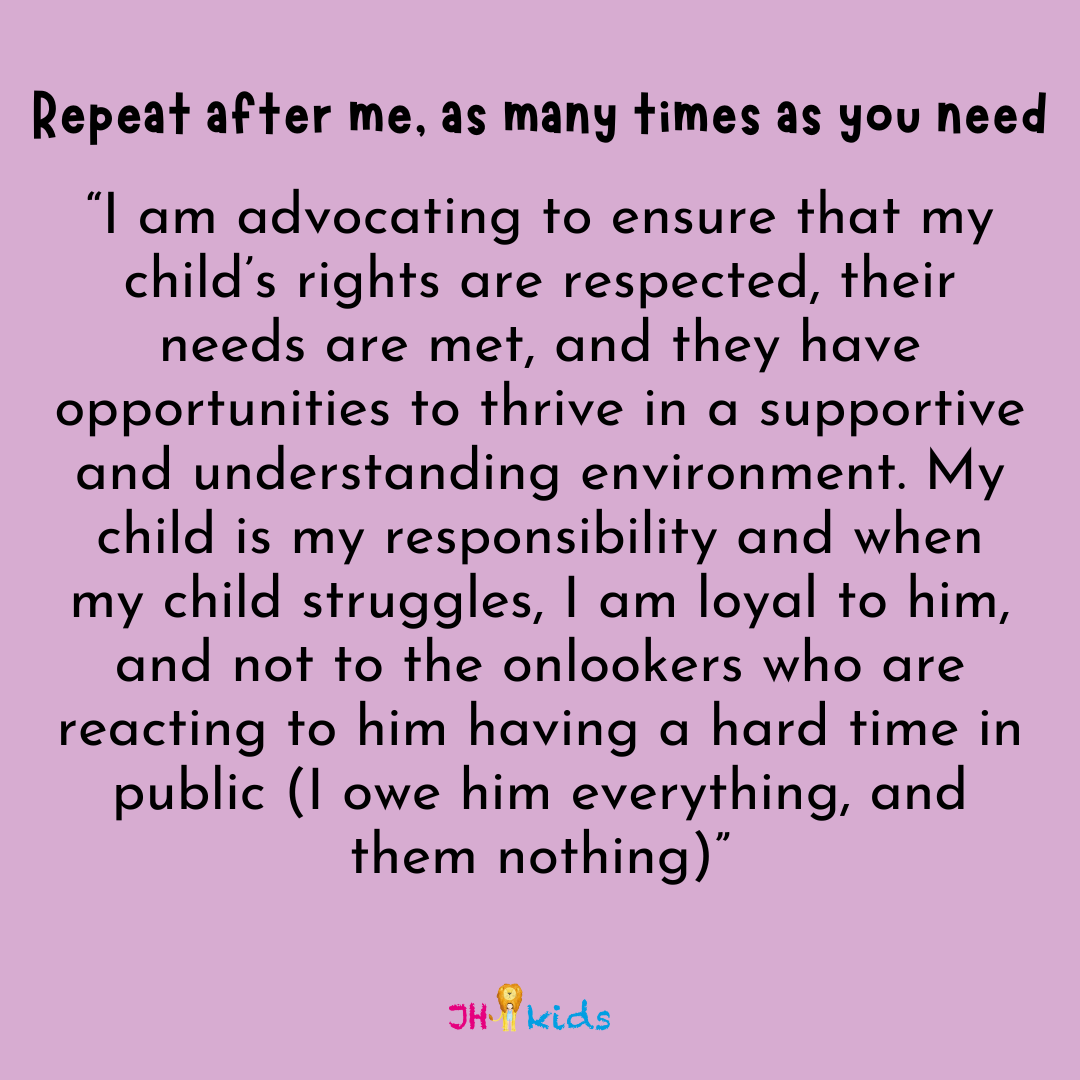
Repeat after me now, or as many times as you need: “I am advocating to ensure that my child’s rights are respected, their needs are met, and they have opportunities to thrive in a supportive and understanding environment. My child is my responsibility and when my child struggles, I am loyal to him, and not to the onlookers who are reacting to him having a hard time in public. I owe him everything, and them nothing”.
Here are some examples of what you may say when advocating:
“I understand that his reading and writing is not on the level of his peers- he has a learning disability, and we can’t ignore the way that his brain processes things, it is not a problem to fix”.
“Are you aware of his incredible visual and auditory memory?”
“I really want to hear what you have to say, can you please call me or email me later and not have this discussion in front of my child”
Here are some examples of what your child may say when self-advocating:
“I read with my ears”
“I have X, this means that my brain learns differently”.
“This is my golden ticket” [referring to his laminated list of accommodations that he is entitled to, which he can show to his teachers when needed, especially useful when there is a substitute teacher].
“I require the test to be read to me, as you can see written on this card”
“I require extra time, as you can see written on this card”
“I need to leave the classroom for some fresh air, you can see it written down on this card. I will be back in 5 minutes”

For me, advocacy means that I am “on top of things”, it means that I know what hours my son is entitled to and with whom and that I ensure he is accessing those hours, it means that when a personal feeling of a team member is shared that doesn’t fit with the team’s approach for various reasons, I can refer back to the psychodiagnostic report and to the letter of services. It means that I know what he is entitled to by law, and that I can refer back to that. It means that I have done research, and I am aware of best practice for his condition. At the beginning of this process, I didn’t have the energy or head space for this. When I can, I do and when I can’t, I outsource while I fill up my reserves.
Ideas for advocating for your child at school
Podcast on why children DON'T self-advocate
Podcast exploring ways that children can self-advocate
Podcast- advocating for your sensitive or neurodiverse child
Accommodations and Modifications
Reading Rockets explains that “Accommodations remove learning barriers in the classroom to provide every child with equal access to learning… and modifications are changes to what a child is taught and expected to do in class.”
Click here to find out more.
The more information we have about what accommodations and modifications exist, the more equipped we are to advocate for our child to receive them. There is a lot of guidance online, I have recommended some websites below.
My son carries around a small, laminated card that has written on it the accommodations and modifications that he is entitled to in the classroom. It is up to him to show it to a new teacher, or when he needs a break.
We have also had to make some accommodations and modifications at home. You can help to understand your child’s sensory profile with an occupational therapist who can help you create a ‘sensory diet’ for your child that can help to keep their nervous system regulated throughout the day.
When my son comes home from school, he immediately goes to the rocking chair, or to the trampoline with a hose. We have come to understand that these activities are his way of regulating his nervous system after a long day. We have also found that a couple of minutes sitting with a parent in the car before coming into the house is helpful.
We have also set up a quiet space, that is dark and cool, and has access to some freezing cold snacks for any of the kids to go to when they feel overwhelmed.
My child used to have a lot of empty time, that he didn’t know how to fill when others would sit on the couch and read a book. The world of reading was closed to him because of his challenges with learning. It didn’t occur to me that my other children at his age, or other kids his age are able to get their daily dose of down time by grabbing a book and reading on the couch. We have since introduced him to audiobooks, and he listens to them in his room, when he needs downtime. Click here to find out more about Downtime. He has learnt to say "I read with my ears". So now we will ask him “What book are you in the middle of?”, even though he is reading it through audiobooks.
Making accommodations for one child can leave siblings feelings confused or jealous. Don’t forget to loop them in where you can.
“Your sibling is going through a hard time, and every task is pushing him over the edge, I know it seems unfair, I hear that. We will always try and create the space for needs to be met, and right now for him, resting and taking the pressure off him is what’s helping him”
Note: This conversation paved the way for that same child feeling jealous to feel comfortable asking for tasks to be done later, or to have some downtime when he felt it was needed because he knows that we are able to make accommodations where needed.
Find out more about:
Accommodations in the classroom for a variety of neurodivergence.

Understanding the Diagnosis Together
As parents, we want to take control where we can, and that means educating ourselves. Understanding the condition, symptoms, challenges, and strengths is something we can do. Chat with others who are further along on the journey, speak to experts, attend workshops, have a look online and know where to turn with yours and your child’s questions.
Here are some videos and links to books on neurodivergence. You can watch/read them with all of your children and have a conversation about it afterwards. Feelings will come up and may show themselves in obvious or less obvious ways. You can also share the list with your child’s teacher and friends.
Neurodiversity for Children part ONE
Neurodiversity for Children part TWO
Jumo health- Understanding ADHD- for ages 2-6
Jumo health- Understanding ADHD- for ages 7-12
What Is Dyslexia?
What It's Like Living on the Autism Spectrum
Sesame Street and Autism
Why Autism is a Difference, not a Deficit
Recommended books to read with your child:
The Brain Forest by Sandhya Menon
My Brain is a Race Car by Nell Harris
A Day with No Words by Tiffany Hammond
Different- a Great Thing to Be!
By Heather Avis
My Brother Charlie by Holly Robinson Peete
All My Stripes: A Story for Children with Autism by Shaina Rudolph and Danielle Royer
Masterpiece by Alexandra Hoffman
Read together, or for older children. You can find these on Audiobooks too.
Fish in a Tree by Lydia Mullaly Hunt
There’s a Boy in the Girls Bathroom by Louis Shachar
Know your limits!
Okay, this is the part that you’ll just have to learn as you go. Most of the time, we don’t realise we have been pushing to our limit until we have surpassed it and need to reset (aka fall apart). You will learn best what works for your family. Be open and flexible- but also confident in what you know as the expert of your family.
You may have been given a strategy of sitting together with your child alone in a dark room when they are having a meltdown. It sounds good in theory, and does work for some, but if you have a newborn in tow, alone at home with small children, or work from home then this strategy probably won't work for your family. You can share your hesitation with the team and hopefully there will be flexibility to adjust the plan to one that is doable.
Personal experience:
At one stage my son was seeing an excellent animal therapist. I would drive him with three other kids in tow and it worked well during school holidays, but once the day-to-day traffic returned, the 10-minute drive turned into a 50-minute drive. After a few bumper-to-bumper drives, I spoke to the therapist, and we were unable to adjust the time. My son had other avenues to express himself and share his process and so we let animal therapy go. The costs greatly outweighed the benefits for our family.
Celebrate wins!
What does it mean to celebrate wins and milestones? It means that we acknowledge achievements, no matter how big or small they may seem. When we highlight the effort, progress and hard work, it encourages us to continue to grow towards further goals.
You can celebrate wins by publicising something your child has done. Maybe you share it on a family chat or at the table within earshot of your child. You can also celebrate wins through rewards and incentives if that works for yourself or your child.
Celebrating a win can be as simple as nodding to your child with a wink when you notice them holding back from reacting in a hurtful or dangerous way.
Or it might be a message that you send to your friend that writes “I deserve the Nobel peace prize for holding it together when x, y or z happened”.
It might mean setting up a meeting with your child and their teacher as an opportunity for both the teacher, yourself and your child to share the growth you have noticed in your child.
*Click here to find out more about the zones of regulation.
Click here for a video that you can show your kids to help explain their zones of regulation.

Does your child need extra support?
Our expert Psychology & Occupational Therapy team can help. At JH Kids, we specialize in supporting children experiencing Autism, ADHD, Dyspraxia, and genetic disorders. Our focus is on supporting children and their families. We offer individualised care to help children build self-awareness, confidence, develop essential skills, and navigate challenges in a safe and understanding environment.
Enquire now to learn more
If you're looking for expert support for your child, we’re here to help.
Proudly supported by